Will flood risk stop me from selling my house?
Published 11 August 2026 · 6 min read · By Evren Ergin
Flood risk rarely stops a sale on its own, but it changes who can buy your home and how the middle of the sale feels. The homes that sell smoothly are the ones where the seller had the flood history and the insurance position ready before the buyer's searches came back.
TL;DR
- •The Environment Agency's national flood risk assessment, published on 17 December 2024, put 6.3 million properties in England in areas at risk of flooding from rivers, the sea or surface water.
- •A flood flag on an environmental search is a question, not a refusal: a lender looks at whether the home can be insured before it looks at anything else.
- •Flood Re, the scheme that keeps flood cover affordable, applies to homes built and council tax banded before 2009, and it runs until 2039.
- •You have to answer the flooding questions on the property information form honestly, and a buyer who finds out later has grounds to walk away.
Advertisement

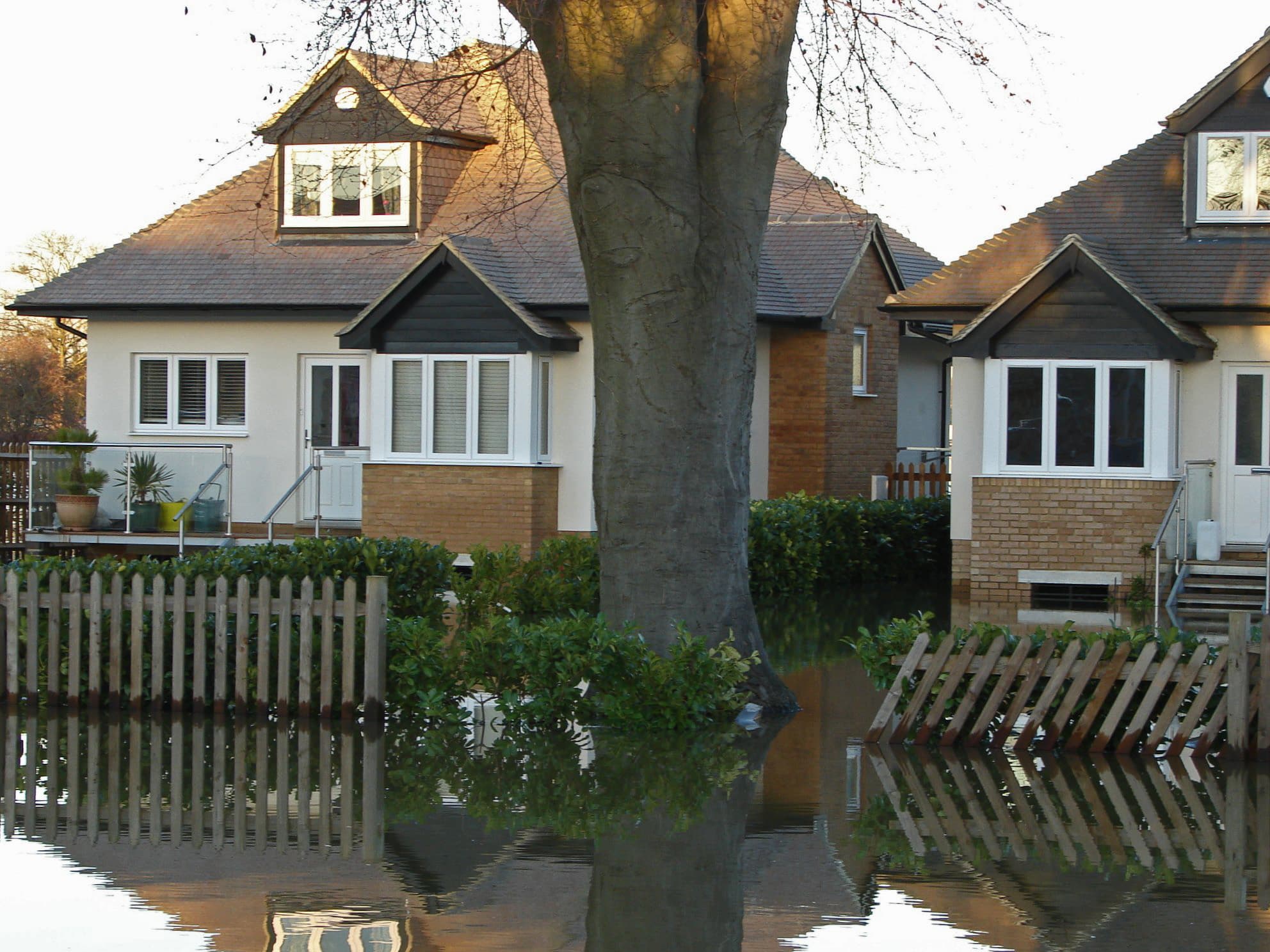
Does flood risk stop you selling a house in the UK?
Flood risk is the chance of water reaching a property from rivers, the sea, surface water (rainfall running off the ground faster than drains can take it) or groundwater. It is published on official maps and it appears on the environmental search your buyer's solicitor orders. It is expressed as a probability band, not as a yes or a no.
So a flood flag does not end a sale. It moves the sale from "does this work" to "can this be insured and lent on", and both of those questions have answers you can gather before you ever go on the market.
The four checks a flood-flagged sale goes through
| Stage | What happens | What decides the outcome |
|---|---|---|
| Environmental search | The buyer's solicitor orders a search that maps flood risk from rivers, the sea and surface water | The risk band, and whether flooding has been recorded at the property |
| Insurance quote | The buyer prices buildings insurance for the address | Whether an insurer will quote at all, and at what premium and excess |
| Lender check | The lender screens the address against flood mapping | Insurability first, then long-term value over the mortgage term |
| Valuation | The surveyor values the home with the risk in view | Past flooding, local defences, and any resilience work you have done |
How many homes in England are at flood risk?
The Environment Agency published its updated National Assessment of Flood Risk on 17 December 2024. It found 6.3 million properties in England in areas at risk from rivers, the sea or surface water, and it projected that figure rising to around 8 million, roughly one property in four, once climate projections are applied.
The Environment Agency was clear that the jump from its 2018 numbers reflects better mapping and modelling rather than a sudden change on the ground. In plain terms: more homes are now flagged, and being flagged is common enough that buyers, brokers and conveyancers deal with it every week.
Will my buyer be able to insure a home at flood risk?
Flood Re is a reinsurance scheme funded by a levy on home insurers. It lets an insurer pass the flood part of a policy into a central pool, which is what keeps premiums and excesses affordable on higher-risk homes. Your buyer never deals with Flood Re directly; their insurer does.
- Covered: houses and most flats that are lived in by the owner or their immediate family, built and council tax banded before 2009, anywhere in the UK.
- Not covered: homes built from 2009 onward, commercial and mixed-use property, holiday homes, and most rented property.
- The scheme runs until 2039, after which flood cover is expected to be priced on the individual risk of each property.
- Eligibility does not oblige an insurer to quote, so a real quote in writing is worth more to a buyer than a note that the home qualifies.
Will a lender refuse a mortgage because of flood risk?
Refusal is the exception. Lenders screen addresses against flood mapping and then work through insurability, valuation and the length of the loan. Where insurance is available at a normal premium, most applications proceed in the usual way.
The pressure point is the small group of homes at the top of the risk range. Research published on 25 March 2026 by Public First with UKSIF estimated that around 430,000 mortgaged homes sit in that group and could find it harder to sell, remortgage or move on, with owners at risk of sitting on a standard variable rate instead of a competitive fixed rate. The same study modelled a price gap of roughly 20% between the most exposed areas and safer ones over time. Those are modelled projections rather than today's sale prices, and they describe the tail of the risk, not the average flagged home.
A flood flag is a question your buyer's lender is going to ask. The seller who already has the answer is the seller whose sale keeps moving.
Do I have to tell buyers my house has flooded?
Yes. The standard property information form used in England and Wales asks directly whether the property has flooded, which parts flooded, when, and what the source was. It also asks whether a flood risk report has been prepared.
Answer it accurately and in full. A buyer who discovers an undisclosed flood after exchange has grounds to claim for misrepresentation, and one who discovers it before exchange usually walks, which costs you months. Disclosure handled early is a detail. Disclosure discovered late is a collapsed sale.
What should I do before putting a flood-risk home on the market?
- Check your own address on the official long term flood risk service for England, or the equivalent service in Wales, Scotland or Northern Ireland, and print the result.
- Dig out your buildings insurance schedule and the last two renewal quotes. A normal premium is the single most reassuring document you can hand a buyer.
- Write a short, factual note of any flooding: the date, the source, how deep, and what was repaired.
- Gather receipts and guarantees for anything protective you have done, such as flood doors, airbrick covers, non-return valves, raised sockets or a repositioned boiler.
- Brief your agent before the listing goes live, so the first mention of flood risk comes from you and not from a search result six weeks in.
- Give the whole bundle to your solicitor at the same time as your property information form, so enquiries are answered in days rather than weeks.
Common questions about selling a home at flood risk
Does flood risk lower my house price?
Not automatically. A flagged risk band with no history of flooding and an ordinary insurance premium often has little effect on price. A home that has flooded, or one an insurer will not quote on, is where a discount tends to appear, because the buyer is pricing in the cost and the hassle rather than the map.
Can a buyer pull out after the environmental search flags flood risk?
Yes. Before exchange of contracts either side can walk away for any reason. That is exactly why flood information belongs at the front of the sale, not in the middle of it.
Is a flood risk report the same as a survey?
No. A flood risk report is a desktop assessment of the flood risk at the address, usually ordered as part of the conveyancing searches. A survey is a physical inspection of the building's condition. They answer different questions and buyers often end up with both.
Does Flood Re cover contents as well as buildings insurance?
Flood Re supports both buildings and contents cover through an eligible home insurance policy. It works behind the scenes with the insurer, so the buyer just buys a normal policy.
My house flooded years ago and never since. Do I still have to say so?
Yes, if the form asks and you know about it. The better move is to pair the disclosure with the evidence: what was done afterwards, what defences went in locally, and your insurance record since.
ValuQ gives UK homeowners free, side-by-side property valuations from competing local estate agents. On a home with a flood flag that matters more than usual, because agents who know the street will price the risk from what has actually sold nearby, and you get to compare their reasoning on one screen before you speak to any of them.
Sources
- [1]Environment Agency, National Assessment of Flood Risk (NaFRA) update · 2024-12-17 · https://environmentagency.blog.gov.uk/2024/12/17/transforming-our-understanding-of-flood-and-coastal-erosion-risk-in-england
- [2]Public First with UKSIF, Flooding the Market: The Climate Mortgage Trap · 2026-03-25 · https://www.publicfirst.co.uk/flooding-the-market-the-climate-mortgage-trap
- [3]Flood Re, scheme eligibility criteria (checked 11 August 2026) · 2026-08-11 · https://www.floodre.co.uk/can-flood-re-help-me/
- [4]GOV.UK, Check the long term flood risk for an area in England (checked 11 August 2026) · 2026-08-11 · https://www.gov.uk/check-long-term-flood-risk
Terms in this article
Plain-English definitions from the ValuQ property glossary.
Exchange of contracts
Exchange of contracts is the moment a sale becomes legally binding, when the two signed contracts are formally swapped and the deposit is paid.
Environmental search
The environmental search screens a property's land for contamination history, flood risk, ground stability and similar hazards from databases.
Misrepresentation
Misrepresentation is a false statement that induces a purchase, giving the buyer a claim for compensation or, rarely, unwinding the sale.
Mortgage term
The mortgage term is the number of years over which the loan is scheduled to be repaid, commonly 25 to 40.
Flood risk
Flood risk is a property's exposure to river, surface water or groundwater flooding, checked through searches and government flood maps.
Flood Re
Flood Re is the industry scheme that keeps flood insurance affordable for higher-risk homes by reinsuring the flood portion of policies.
Read next
Related insights
Can I switch estate agent while my house is on the market?
Can my estate agent use AI to edit photos of my house?
A buyer wants to film my house at the viewing. Should I let them?
How do I know if my estate agent is doing enough?
What is your home worth today?
ValuQ gives UK homeowners free, side-by-side property valuations from competing local estate agents. Anonymous until you choose. No cold calls.
Get your free anonymous valuationSellers and buyers never pay.