More homes are coming to market. Buyers haven't followed.
Published 13 August 2026 · Reviewed 10 September 2026 · 5 min read · By Evren Ergin
When this article was first published, the flow of homes coming to market had started to recover while buyer numbers sat still. The August 2026 RICS survey, published on 10 September 2026, changed that picture: buyer enquiries have now improved for a fifth month in a row, and it is the pipeline of homes behind them that has started to thin instead.
TL;DR
- •RICS reported on 10 September 2026 that new buyer enquiries improved to a net balance of -19% in August, the least negative reading since January and a fifth consecutive monthly improvement.
- •New instructions were flat at 0%, so the number of homes coming to market is steady rather than surging.
- •Market appraisals, the valuation visits that happen before a home is listed, ran at -17% below the level a year earlier, pointing to thinner competition later in the autumn.
- •The house price balance was -28%, so agreed prices are still drifting down even as activity improves.
Advertisement

A net balance is the share of surveyors reporting a rise minus the share reporting a fall. A reading of -19% does not mean buyer numbers fell 19%. It means 19 percentage points more respondents saw demand fall than saw it rise.
What changed between July and August 2026?
This article was written on the July release. The August survey, published on 10 September 2026, moved the story on in two ways worth being clear about.
- Buyers did follow, slowly. New buyer enquiries improved from the summer lows to -19% in August, the fifth monthly improvement in a row and the least negative reading since January.
- Supply stopped being the story. New instructions came in flat at 0%, and the appraisal pipeline behind them turned negative at -17%.
- RICS also restated some earlier figures, as it often does. July new instructions are now shown as -2% rather than the -4% first reported, and the July price balance as -29% rather than -30%.
RICS UK Residential Market Survey, net balances, July to August 2026 (August release published 10 September 2026)
| Measure | July 2026 | August 2026 | Direction |
|---|---|---|---|
| New buyer enquiries | Improving through the summer | -19% | Least negative since January |
| Agreed sales | -38% at the April low | -17% | Strongest since February |
| New instructions | -2% (revised) | 0% | Flat |
| Market appraisals | Not comparable | -17% | Below a year earlier |
| House price balance | -29% (revised) | -28% | Marginally better |
| Sales expectations, three months | -13% | -3% | Close to neutral |
| Sales expectations, twelve months | +3% | +6% | Improving |
Why does the appraisal number matter now?
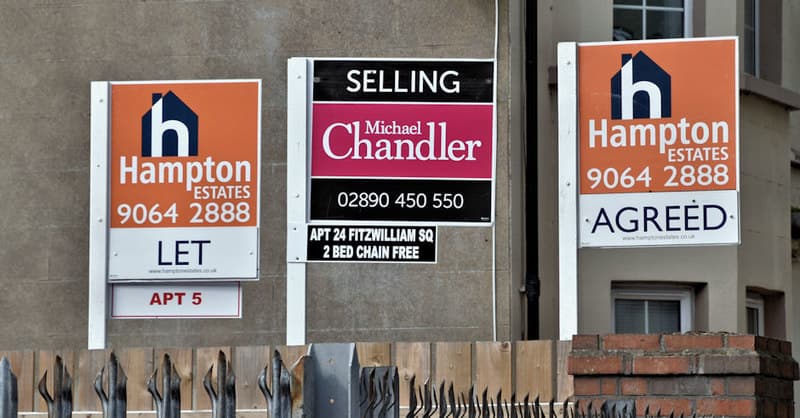
A market appraisal is the valuation visit an agent or surveyor makes to a home before it is listed. It happens weeks or months before a For Sale board goes up, which makes it the closest thing the market has to a supply forecast.
At -17%, more respondents saw fewer of those visits than a year earlier than saw more. With instructions flat at 0%, the reading is that today's market is about as crowded as it was, and the queue forming behind it is shorter.
Thinner competition improves your chances of being seen. The price is still set by what a buyer can borrow.
Are house prices actually falling?
Surveyor sentiment and sold prices still tell slightly different stories, which is normal. The RICS price balance stood at -28% in August, so more respondents saw agreed prices fall than rise, and they expect prices to keep softening over the next three months before steadying on a twelve-month view.
Asking prices remain the softer number. Rightmove's August index, published on 17 August 2026, recorded a 2% monthly fall in new seller asking prices to an average of £364,999, the largest August drop since 2018, and Rightmove revised its 2026 forecast to between 0% and -2%.
What is holding buyers back?
Borrowing costs. As of 9 September 2026 the Bank of England base rate stood at 3.75%, with the next Monetary Policy Committee decision due on 17 September 2026.
Average rates that day were 5.29% on a two-year fix and 5.31% on a five-year fix at 75% loan to value, against a standard variable rate of 7.34%. Jeremy Leaf, a north London agent quoted in the August survey, put the pickup down to holiday returnees restarting their searches, in lower volumes than last year.
What should I do if my home is already on the market?
- Look at what has come on near you in the last three weeks rather than what was listed in spring. Your competition set changes faster than the national data.
- Ask your agent for viewing numbers rather than opinions. Viewings are the honest measure of whether your price is landing.
- If you are getting viewings and no offers, the issue is usually the property or the presentation. If you are getting neither, it is usually the price.
- Work out the net figure you would actually walk away with at a lower price before you agree to a reduction, so the decision is arithmetic rather than nerves.
- Treat the improving demand numbers as a reason to stay on the market rather than a reason to hold out for more. The price balance is still negative.
What if I have not listed yet?
The twelve-month sales expectation improved to +6% in August, and it is worth reading carefully. It is a forecast of sentiment, not a promise, and it comes from the same respondents reporting falling prices today.
The stronger move is to find out where your home genuinely sits before you commit to anything. ValuQ gives UK homeowners free, side-by-side property valuations from competing local estate agents, so you can see several considered opinions on one screen before you speak to a single agent.
What is the honest read for sellers this month?
The market is grinding back rather than turning. Demand has improved for five months running, supply today is flat, and the pipeline behind it is thinner than last year. A well-priced home in good order still sells, and it now has a slightly better chance of being noticed.
What has not changed is pricing power. Buyers are still setting the number, because rates are still setting their budgets.
Sources
- [1]RICS UK Residential Market Survey, August 2026 · 2026-09-10 · https://www.rics.org/news-insights/market-surveys/uk-residential-market-survey
- [2]The Intermediary: Housing market stabilises in August as rent expectations rise, RICS · 2026-09-10 · https://theintermediary.co.uk/2026/09/housing-market-stabilises-in-august-as-rent-expectations-rise-rics/
- [3]Property Industry Eye: Housing market steadies but rent rise expectations surge · 2026-09-10 · https://propertyindustryeye.com/housing-market-steadies-but-rent-rise-expectations-surge/
- [4]Uswitch: UK mortgage rates today · 2026-09-09 · https://www.uswitch.com/mortgages/uk-mortgage-rates-today/
- [5]Rightmove House Price Index, August 2026 · 2026-08-17 · https://www.rightmove.co.uk/news/house-price-index/
- [6]RICS UK Residential Market Survey, July 2026 (original basis for this article) · 2026-08-13 · https://www.rics.org/news-insights/market-surveys/uk-residential-market-survey
Terms in this article
Plain-English definitions from the ValuQ property glossary.
Base rate
The base rate is the interest rate the Bank of England sets, which flows through to mortgage pricing across the market.
Market appraisal
A market appraisal is an estate agent's opinion of what your home would sell for, given free in the hope of winning your instruction.
For sale board
A for sale board is the agent's sign outside your home, and it still generates enquiries from neighbours and passers-by.
RICS
RICS is the Royal Institution of Chartered Surveyors, the professional body that sets the standards UK surveyors and valuers work to.
Read next
Related insights
Can I switch estate agent while my house is on the market?
Can my estate agent use AI to edit photos of my house?
A buyer wants to film my house at the viewing. Should I let them?
How do I know if my estate agent is doing enough?
Know what your home is worth today
ValuQ gives UK homeowners free, side-by-side property valuations from competing local estate agents. Anonymous until you choose. No cold calls.
Get your free anonymous valuationSellers and buyers never pay.